
Advanced Jasper AI hacks focus on prompt engineering, templating, and integrations that accelerate ideation, outlining, drafting, and optimization for blog production. This article teaches actionable techniques to reduce time-per-article while preserving quality and search performance, including copyable prompts, workflow patterns, SEO best practices, brand-voice training, scaling strategies, and human+AI fact-checking. Many content teams struggle with slow ideation, inconsistent voice, and HCU compliance; the methods below solve those issues by combining precise Jasper AI commands, reusable templates, and targeted integrations to produce publish-ready drafts faster. You will learn the most effective advanced tips for speeding writing, a step-by-step optimized workflow, SEO tactics tied to tooling, brand-voice mastery, scaling levers for volume, and human-AI review patterns that reduce risk under Google’s 2024 Helpful Content Update. Throughout, I reference relevant integrations such as Surfer SEO, Copyscape, WordPress, and complementary tools like Grammarly and GPT-4 where they illustrate practical implementation. Read on for copyable prompts, EAV comparison tables, and repeatable workflows designed for immediate application.
What Are the Most Effective Jasper AI Advanced Tips for Speeding Up Blog Writing?
Effective advanced tips for speeding blog writing use chained commands, explicit context windows, and parameterized templates to turn a seed idea into a publishable draft quickly. These techniques work because they constrain the model’s output with structured prompts and reusable artifacts, which reduces iteration and revision time while preserving readability. The result is faster ideation, clearer outlines, and higher-quality first drafts that require less human rework. Below are practical, high-impact hacks you can copy and adapt to your editorial process.
The following list summarizes the top advanced hacks you should adopt immediately to cut time-to-first-draft.
- Chain short commands so each output becomes the next prompt context to build outlines and sections.
- Use a fixed context window with anchor text and style rules to maintain brand voice across generations.
- Create parameterized templates for article types (how-to, listicle, long-form) and feed a keyword set per run.
- Include explicit role and intent lines (e.g., “Act as an SEO copywriter and produce…”) to align tone and function.
These hacks reduce friction between ideation and drafting and naturally lead into specific command patterns for idea generation and outline creation.
How Do Jasper AI Commands Accelerate Idea Generation and Outlining?

Jasper AI commands accelerate idea generation by taking a seed topic and producing ranked variations, niche angles, and audience-specific hooks within a single chained session. A typical command pattern instructs the model to generate ten headline variants, then filter three by audience persona and then expand one into a hierarchical outline, which preserves context across outputs and eliminates manual rework. The mechanism relies on short, focused prompts plus a persistent context block that contains keywords, persona, and target intent, which guides each successive command. Expect fast, usable outputs when you include constraints like target word counts per section and a list of required subtopics. These patterns cut early-stage brainstorming time and produce structured outlines ready for section drafting.
This method sets up the next stage: turning those outlines into polished paragraph drafts with precise expansion prompts.
Which Jasper AI Prompts Enhance Draft Creation and Content Expansion?
Prompts that enhance draft creation instruct Jasper to expand a concise outline point into a complete paragraph with specified voice, length, and SEO targets, which yields coherent, publishable prose faster than freeform prompting. Use a template prompt such as: “Expand this outline point into a 120–150 word paragraph in an authoritative yet conversational tone, include the keyword [X], and add one example or statistic.” That formula produces paragraphs that fit editorial guidelines and reduce round-trip edits. For expansion of existing copy, prompt the model to retain the original meaning while improving clarity and adding subpoints; include markers like “Preserve the claim, add two supporting bullets, and suggest an internal link.” When you apply temperature and creativity controls conceptually—favoring lower creativity for factual sections and higher for opinion—you get consistent style across sections. These expansion prompts prepare drafts that require minimal human polishing and lead naturally into how to chain commands at scale.
How Can You Optimize Your Jasper AI Workflow for Maximum Efficiency?
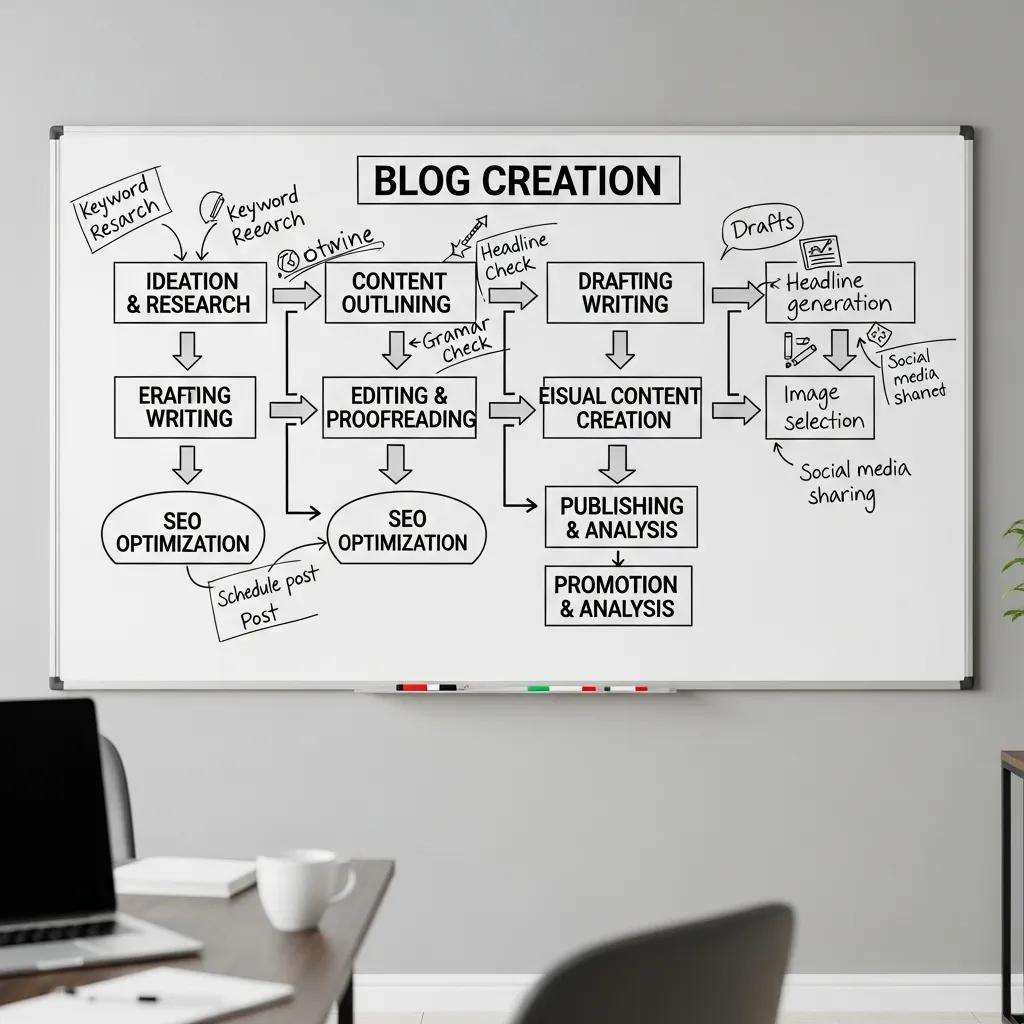
An optimized Jasper AI workflow orchestrates ideation, outline expansion, draft generation, SEO pass, and publish handoff in ordered steps to minimize idle time and avoid repeated context setup. The core pattern defines roles for each stage, reuses templates with parameter substitution, and automates routine checks so humans focus on high-value edits. By standardizing this flow, teams reduce friction between stages and cut overall throughput time without sacrificing quality. The workflow below codifies those stages into a reproducible process that teams can implement immediately.
Follow this numbered workflow to move from idea to publish-ready draft with minimal manual overhead.
- Seed idea and keyword list: generate multiple angles and select one with quick validation.
- Produce a hierarchical outline using chained commands and required subheadings.
- Expand each outline node into paragraph drafts using expansion prompts and tone constraints.
- Run an SEO optimization pass and originality checks, then perform human editing and finalization.
This stepwise approach leads into practical patterns for combining commands and managing templates for repeated use.
Before reviewing specific integration components, compare common workflow elements and their use-cases to determine which to standardize.
This table highlights which workflow components deliver the largest efficiency gains and helps prioritize automation investments. Standardizing templates and chaining commands creates predictable outputs and reduces repetitive setup across articles.
What Are the Best Practices for Combining Jasper AI Commands into Seamless Workflows?
Best practices for combining commands include explicit naming conventions for templates, a single persistent context block, and modular prompts that accept parameters to avoid rebuilding context for every run. Organize templates by article type and include placeholders for persona, keywords, and CTAs so the same template can be batch-run with different inputs. For chaining, capture the output of each step and pass it as the “context” into the next command using consistent labels like “Outline:” or “SectionDraft:”. Error handling means writing fallback prompts that ask the model to rephrase or fix missing elements, which reduces manual corrections. Version control of template revisions and a simple change log ensures teams can iterate templates safely while keeping outputs consistent across projects.
Adhering to these practices sets up smooth integrations with SEO and CMS tools that accelerate publish cycles.
How Do Integrations with Tools Like WordPress and Surfer SEO Improve Blog Production?
Integrating Jasper with CMS and SEO tools speeds production by minimizing manual copying and enabling real-time optimization feedback within the authoring loop. For example, exporting drafts directly to a publishing platform removes a step in the pipeline, while running a Surfer SEO-style optimization pass during editing aligns structure and keyword usage to a target score before human review. Running a Copyscape originality check in the loop catches duplication early and preserves content integrity. These integrations shorten time-to-publish, reduce context switching among tools, and raise baseline content quality prior to editorial polish.
By linking generation to optimization and publishing tools, teams shrink the gap between AI output and live content, which increases throughput and lowers revision cycles.
For teams using Jasper and complementary tools, brief factual context on product features and integrations clarifies what to enable in a pipeline.
Jasper AI offers functionality such as Boss Mode, Templates, and integrations like Surfer SEO that teams use to operationalize the workflow patterns above. Boss Mode and Templates help maintain long context and reusable structures, while Surfer SEO integration supports on-the-fly content scoring and alignment. These features are practical examples of how to implement chained command sequences and automate CMS handoffs without inventing new processes. Mentioning these capabilities helps readers map the workflow primitives to product features they may already have access to, enabling faster adoption.
What Are Jasper AI SEO Best Practices to Boost Blog Rankings?
Jasper AI SEO best practices center on instructing the model to generate keyword-aware content, crafting optimized meta elements, and producing FAQ/PAA-style content that targets search snippets. The mechanism involves supplying keyword lists, intent signals, and required SERP features to each prompt so outputs match searcher intent and on-page expectations. When you combine semantic prompting with post-generation audits using SEO tools, the content aligns better to ranking signals and PAA opportunities. Below are actionable best practices you can apply immediately.
Use the short checklist below to implement SEO-focused generation and optimization.
- Include primary and secondary keywords in the prompt and ask for natural placement within headings and the first 100 words.
- Ask the model to generate three meta description variants with different CTAs and lengths suitable for SERP snippets.
- Produce an FAQ block with PAA-targeted questions and concise answers to increase SERP real estate.
These practices make drafting SEO-optimized posts more predictable and prepare content for a subsequent tooling pass like Surfer or Copyscape.
Before the table, here’s a quick comparison of SEO-related integrations and expected outputs to guide optimization sequencing.
This EAV-style comparison clarifies which step addresses which SEO risk: Surfer for structure, Copyscape for originality, and prompt-based meta commands for snippet readiness. Use this sequence—generate → optimize → originality check → human edit—to reduce rework and maximize ranking potential.
After optimizing prompts and tools, you can use Jasper’s meta commands and integrations to implement these practices directly.
Jasper AI commands for keyword and meta generation—paired with Surfer SEO scoring and Copyscape originality checks—are practical examples of integrating SEO into the authoring loop. Use keyword/meta-description commands to generate title variants and short meta descriptions, then validate those outputs with an SEO score and an originality check before human editing. This sequence reduces last-mile edits and increases confidence that content meets both search and editorial standards.
How Can You Master Brand Voice and Content Consistency Using Jasper AI?
Mastering brand voice with Jasper AI requires supplying exemplar copy, explicit style rules, and iterative feedback to the model so it learns consistent tone, word choices, and sentence rhythms across posts. The technique works by combining representative paragraphs, a style checklist, and controlled prompts that enforce voice anchors such as formality, humor level, and signature phrases. The outcome is content that feels cohesive to readers and strengthens brand recognition. Below are specific techniques and validation steps to build repeatable voice templates.
Start by collecting voice exemplars and translating them into concise style rules that the model can reference.
- Provide 3–5 exemplar paragraphs that embody the desired tone.
- Create a short style guide with required and forbidden terms and typical sentence length.
- Implement a voice-check prompt that scores new drafts against the exemplar set and lists deviations for human editors.
This process ensures the model mirrors complex brand tones and prepares content for measurement and continuous refinement.
What Advanced Techniques Train Jasper AI to Replicate Complex Brand Tones?
Advanced techniques include iterative fine-tuning of prompt templates, storing voice templates with labeled variables, and running comparative scoring between model outputs and exemplar texts to quantify divergence. Feed the model several representative paragraphs and a concise rule set, then ask it to rewrite test passages to match those rules. Use a scoring checklist—readability, tone match, vocabulary alignment—to identify persistent mismatches and refine prompts accordingly. Storing voice templates with placeholders for persona and channel simplifies reuse and helps maintain consistency across article types. Iterative feedback loops between writers and the model accelerate convergence toward a stable brand voice that requires less human correction over time.
Refining brand voice in this way naturally improves reader engagement and supports SEO through stronger user signals.
How Does Maintaining Brand Voice Improve Reader Engagement and SEO?
Consistent brand voice improves reader engagement by creating predictable, trust-building experiences that increase time on page, repeat visits, and click-through rates—metrics that search engines use as indirect quality signals. When readers encounter coherent tone and useful content, they spend more time reading and are more likely to convert or share, which strengthens perceived authority. Applying a consistent voice also aids site-wide cohesion, making internal linking and topical clusters more persuasive to both users and search algorithms. Measurement should include engagement KPIs like average session duration and CTR to validate improvements and iterate on voice templates. Tracking these metrics creates a feedback loop that ties brand consistency directly to SEO outcomes.
Maintaining voice consistency also supports scalable content production, which is discussed next.
What Are the Best Strategies to Scale Blog Content Production with Jasper AI?
Scaling blog content production with Jasper AI relies on custom templates, batch automation, clear team roles, and measurement to ensure volume growth without quality loss. Templates parameterized by article type, keyword sets, and CTAs allow batch generation of first drafts, while automation triggers and scheduled runs turn those templates into regular content pipelines. Team roles—template managers, SEO reviewers, and final editors—keep quality gates intact and reduce bottlenecks. Monitoring metrics like content velocity, pass-rate on originality checks, and human editing time helps iterate on templates and automation. The strategies below outline the levers you can pull to increase throughput with predictable quality controls.
The list below highlights core scaling strategies you can implement immediately.
- Build a template library segmented by article type and audience with placeholders for keywords and examples.
- Implement batch generation: feed a keyword list into the template to produce multiple drafts in one session.
- Define a minimal editorial pass for QA to maintain quality while enabling higher throughput.
This EAV-style table ties specific scaling levers to expected outcomes and reflects industry-observed improvements such as doubled or tripled content output and reduced production costs when templates and automation are applied. Monitoring these levers helps teams scale deliberately and measure ROI.
Real-world, generalized results reported by users indicate meaningful efficiency gains when teams standardize templates and automation: a significant share of users report saving at least five hours per week, many teams produce roughly two to three times more content, and production costs often decrease by around thirty percent. Using these benchmarks helps teams set realistic targets for throughput and staffing as they adopt scalable Jasper-driven pipelines.
How Do Human-AI Collaboration and Fact-Checking Improve Jasper AI Blog Quality?
Human-AI collaboration and rigorous fact-checking are essential to produce high-quality content and avoid penalties associated with low-value or misleading AI-generated pages under Google’s 2024 Helpful Content Update. Human reviewers add domain expertise, verify claims, and inject original insights that AI alone cannot reliably produce. A structured human+AI review loop—generate, originality check, fact-verify, human edit, finalize—ensures content demonstrates clear expertise and purpose. The following sections outline why human editing matters and which tools and workflows support effective verification.
Why Is Human Editing Essential to Avoid Google’s 2024 Helpful Content Update Penalties?
Human editing is essential because Google’s 2024 Helpful Content Update penalizes content that lacks human value, demonstrable expertise, or original insight—qualities that raw AI output often does not consistently provide. Human editors validate factual claims, add sourcing or first-hand insights, and contextualize AI-generated passages to reflect real expertise and purpose. Editors also ensure the article answers user intent beyond surface-level treatment, which aligns with HCU’s emphasis on helpful, people-first content. A practical checklist includes verifying facts against authoritative sources, adding unique examples or case notes, and ensuring clarity of purpose in the opening and conclusion. Following these steps reduces the likelihood of HCU-related ranking setbacks and increases the long-term value of published content.
What Tools and Workflows Support Effective Fact-Checking and Content Refinement?
Effective fact-checking workflows combine originality checks, authoritative source verification, and editorial QA to refine AI drafts into reliable content. Use plagiarism/originality tools to flag duplication early, then cross-verify key claims with primary sources and expert references to ensure accuracy. Implement a staged workflow: generate → run Copyscape-style originality check → verify facts with authoritative sources → human edit for clarity and voice → final editorial sign-off. Assign quality thresholds such as acceptable originality scores and require an editor’s sign-off for technical claims. Complementary tools like Grammarly help polish readability while domain-specific databases assist with verification. These steps streamline review and ensure content meets both editorial and algorithmic standards.
Human-AI collaboration executed through these workflows completes the pipeline and prepares content for publishing under robust quality controls.