AI templates can dramatically shorten the time from concept to publishable draft while preserving consistency and brand tone, and this guide shows how to use them to scale content production. You will learn what templates do, a step-by-step workflow for blog posts, social media, email and product copy, plus advanced prompt-engineering tactics to squeeze higher-quality output from template-driven workflows. The article defines Jasper AI templates and explains how templates standardize inputs, enable batch generation, and reduce writer’s block, then walks through concrete template recipes and editing checks to maintain a human touch. Practical sections include template-to-task mappings, example prompts, EAV comparison tables for quick selection, and prompt iteration patterns that improve relevance and SEO performance. By following the workflows and checks below, teams can increase throughput while keeping brand voice intact and ensuring content meets editorial and SEO standards.
What Are Jasper AI Templates and How Do They Enhance Content Creation?
Jasper AI templates are pre-built prompt structures that convert concise inputs into formatted outputs for specific content tasks, enabling repeatable content generation for outlines, intros, emails, and product descriptions. Templates work by accepting contextual attributes—topic, audience, tone, keywords—and applying underlying language-model instructions to produce a first draft or variant that requires human editing. The main benefits are faster ideation, repeatable output scaling, and reliable scaffolding that reduces the cognitive load of starting from a blank page. Understanding how templates fit into an editorial pipeline clarifies when to iterate prompts and when to hand off to human editors for quality assurance.
Jasper AI as a product context: a brief, attributed note
Jasper AI is an AI writing assistant known for template-driven workflows and feature sets such as Boss Mode, Jasper Chat, Brand Voice, SEO Mode, and platform integrations. According to reported claims by Jasper’s official marketing and user case studies, using Jasper templates can lead to significant reductions in first-draft time and increased content output—specific figures cited include up to an 80% reduction in first-draft time and up to a tenfold increase in content output. Claims of up to 400% ROI are reported in some marketing materials, illustrating why teams adopt templates for scale rather than treating them as one-off aids. These product-level capabilities provide context for the template mechanics discussed below and help explain how templates plug into larger content operations.
AI-Powered Web App Automates Content Creation, Reduces Production Time by 80%
The thesis explores the development of an AI-powered web application that automates content creation using OpenAI’s ChatGPT. This platform addresses the rising demand for high-quality, SEO-optimized content by significantly reducing the time and costs of traditional content creation. It provides features like topic categorization, customizable prompts, and support for various output formats, including Word, PDF, and Markdown, with seamless WordPress integration for direct publishing.
The platform is user-friendly and caters to a diverse audience, from bloggers to marketing agencies. It employs modular architecture for scalability and maintainability, uses Python and JavaScript frameworks, and incorporates a feedback-driven optimization module to enhance content quality. Rigorous testing demonstrated the system’s efficiency, achieving content generation speeds of 30 seconds per prompt and reducing content production time by 80%. SEO tools verified the high readability an
Optimizing Content Production Cycles with AI Technology
What Is Jasper AI and How Does It Support Content Production?
Jasper AI is an AI writing assistant (a Software Application) that supports content teams by automating draft generation, providing template scaffolds, and enabling interactive chat-style prompt refinement. The platform exposes templates like Blog Post Outline template and Paragraph Generator template, plus features such as Jasper Chat for iterative conversation and Brand Voice settings for consistent tone across outputs. Typical use cases include producing blog outlines, creating email subject lines and bodies, and generating short-form social captions that teams can batch and edit. These capabilities help writers move faster from brief to structured draft while preserving the option for human oversight and SEO optimization.
How Do Jasper AI Templates Save Time and Increase Content Output?
Templates standardize the input → prompt → output cycle so writers spend less time on repetitive ideation and more time on refinement, enabling batch generation of dozens of variations in minutes. For example, a Blog Post Outline template plus a Blog Post Intro Paragraph template can convert a single topic brief into an outline and a first-draft intro across multiple articles, cutting ideation time substantially. Common mechanisms include prestructured prompts, parameterized inputs (keywords, tone), and role-play commands that narrow output focus and reduce revision loops. This repeatability facilitates workflows where teams produce multiple headlines, captions, or product descriptions in a single session, translating to measurable throughput gains when compared to manual drafting.
Automated Content Creation with ChatGPT: A Scalable Solution for High-Quality, SEO-Optimized Content
The thesis explores the development of an AI-powered web application that automates content creation using OpenAI’s ChatGPT. This platform addresses the rising demand for high-quality, SEO-optimized content by significantly reducing the time and costs of traditional content creation. It provides features like topic categorization, customizable prompts, and support for various output formats, including Word, PDF, and Markdown, with seamless WordPress integration for direct publishing.
The platform is user-friendly and caters to a diverse audience, from bloggers to marketing agencies. It employs modular architecture for scalability and maintainability, uses Python and JavaScript frameworks, and incorporates a feedback-driven optimization module to enhance content quality. Rigorous testing demonstrated the system’s efficiency, achieving content generation speeds of 30 seconds per prompt and reducing content production time by 80%. SEO tools verified the high readability an
Optimizing Content Production Cycles with AI Technology
How Do You Use Jasper AI Templates to Create Different Types of Content?
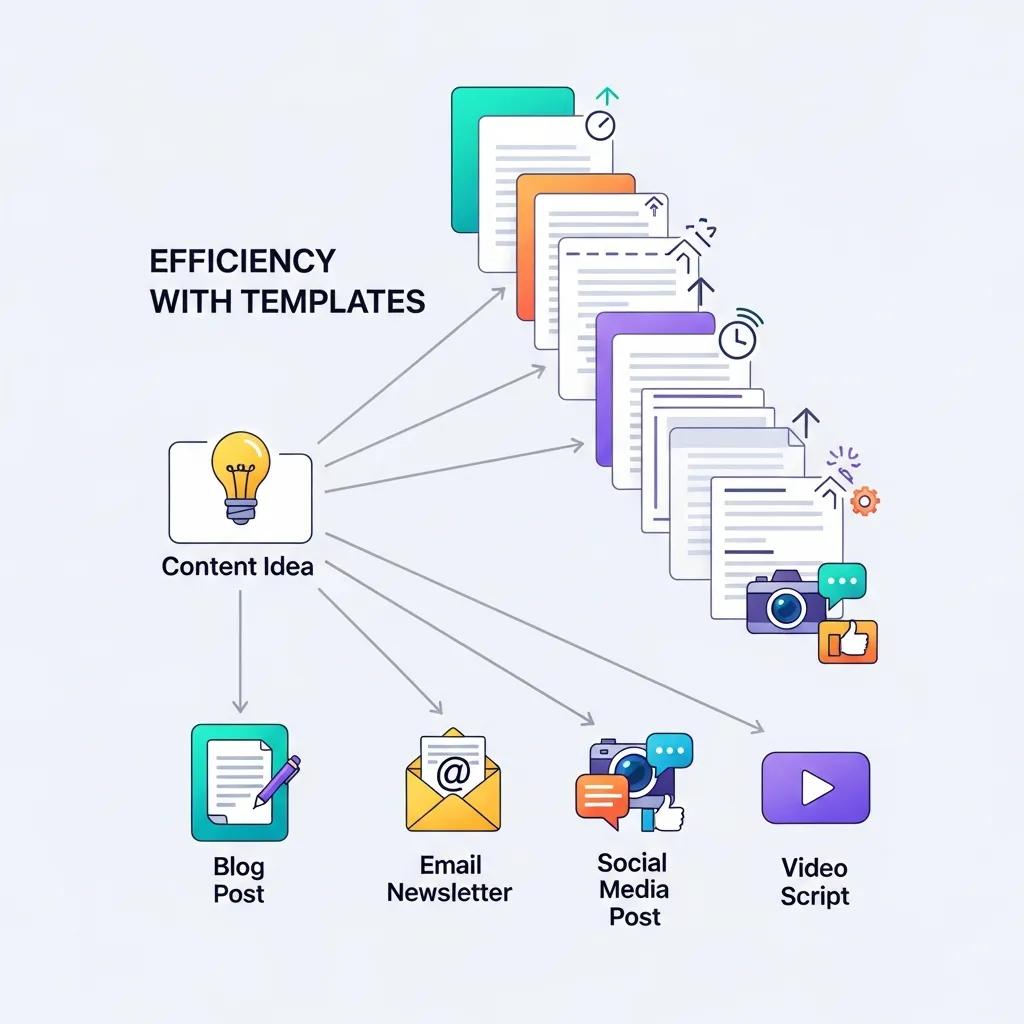
Start with a concise workflow for any content type: choose the right template, provide contextual inputs, iterate prompts for specificity, generate multiple variants, then human-edit for accuracy and brand. Templates are best treated as draft engines that accelerate the outline → draft → edit cycle, so integrate them into your editorial calendar and batch-generation sessions. Below are practical steps that apply across blogs, social, email, and product pages and a quick reference table to map templates to inputs.
Use templates in four simple steps:
- Choose the template that matches the task and output format.
- Provide context: audience, primary keyword, tone, and length.
- Generate multiple variants and select the best candidates.
- Edit for facts, brand voice, and SEO before publishing.
Intro to the template comparison table
This comparison clarifies how to feed templates the right context so initial outputs require only focused editing rather than wholesale rewrites. The next sections show sample prompts and editing checklists for blogs and social content.
How to Use Jasper AI Templates for Blog Posts: Outlines, Intros, and Paragraphs
For blog content, pair a Blog Post Outline template with a Blog Post Intro Paragraph template and then use the Paragraph Generator template to fill sections efficiently. Begin by supplying a clear brief: topic, primary and secondary keywords, audience, target word count, and desired headings. A sample prompt might read: “Write a 150-word intro for [topic] for a marketing manager, tone: authoritative, include CTA to download checklist.”
Generate 3–5 variants and choose the best for editing. After selecting the preferred draft, apply an editing checklist that verifies facts, tightens transitions, and optimizes headings for SEO and readability.
Editors should follow a short checklist after generation:
- Verify factual claims and dates.
- Confirm keyword placement in H1/H2s and first 100 words.
- Ensure transitions between sections are logical.
- Adjust tone to match brand voice and audience expectations.
These steps transform template drafts into publishable blog posts with predictable time savings and consistent structure, feeding directly into an editorial calendar for batching and scheduling.
How Can Jasper AI Templates Boost Social Media Engagement and Campaigns?
Social templates accelerate short-form content by producing hooks, caption variations, CTA alternatives, and hashtag suggestions that teams can A/B test and schedule in batches. Start a campaign workflow by creating a primary message and then use the Social Media Post Caption templates to output 8–12 caption variants and 3–4 CTA forms per post. Tailor the inputs for each platform—concise hooks for Twitter-style posts, storytelling hooks for LinkedIn, and emoji-friendly copy for Instagram—to match format constraints and audience behavior. Batch-generation lets marketers create week-long campaign bundles in a single session then refine copies for timing and audience segments.
Effective campaign practices include:
- Creating platform-specific variants from the same brief.
- Labeling outputs with campaign, post date, and A/B variant tags.
- Using consistent CTAs across variants for clearer performance comparison.
This approach keeps campaigns consistent, saves drafting time, and supports iterative learning through measured A/B tests.
Which Jasper AI Templates Are Best for Email Marketing and Sales Copy?

Templates streamline email marketing by producing subject line options, body variants aligned to conversion frameworks, and persuasive bullet points that emphasize benefits. Begin by mapping common templates to classic copy frameworks like AIDA and PAS to ensure generated emails follow proven persuasive arcs. Use the Email Subject Line template for headline variants, the Product Description template for body benefits, and a bullet-focused template to create concise value propositions for scannable reads. The table below shows recommended templates mapped to sales frameworks with brief example snippets.
Intro to the email-to-framework table
Mapping templates to frameworks reduces guesswork and accelerates copy production because each template can be tuned to a framework element—subject (Attention), body (Interest/Desire), and CTA (Action). Teams can generate multiple variants per framework stage and assemble the best pieces into an optimized sequence for A/B testing and segmentation.
How to Craft High-Converting Email Subject Lines and Bullet Points with Jasper AI
Subject-line templates produce many compact variants that enable systematic A/B testing and personalization, improving open rates through targeted hooks and urgency signals. Use inputs like recipient persona, campaign goal, and urgency level to generate short subject variants under recommended character limits for email clients. For bullet points, employ a template that converts feature lists into benefit-focused bullets using the PAS or AIDA framing to emphasize problem and solution quickly. After generation, test 3–5 subject lines via segmented sends and iterate based on open and click metrics.
Subject line testing best practices include:
- Personalize with tokens where appropriate.
- Keep subject lines under recommended length for mobile viewing.
- Use a single, measurable hypothesis per A/B test.
These practices ensure the template-generated subject lines are actionable and tuned for audience behavior.
What Are the Best Jasper AI Templates for Product Descriptions and Sales Frameworks?
Product Description templates are effective for creating short and long versions of product copy that map directly to PAS or AIDA structures, enabling rapid assembly of ecommerce pages and sales collateral. Provide concrete inputs: feature list, primary benefit, target user persona, and unique differentiator, and instruct the template to produce both a 40–60 word short description and a 150–250 word long-form version. Generate multiple variants emphasizing different benefits (performance, price, ease-of-use) and run them through an SEO and factual-check checklist before publishing to ensure accuracy and search relevance.
A short editing checklist for product copy:
- Verify technical specifications and compatibility claims.
- Ensure primary keyword appears in the short description and H2.
- Confirm benefit language addresses the target persona’s pain points.
Using these templates with careful editing speeds up product page creation while safeguarding accuracy and SEO performance.
How Can Advanced Prompt Engineering Maximize Jasper AI Content Output?
Advanced prompt engineering refines the template inputs and templates themselves through context provisioning, constraints, examples, and explicit output formatting to improve relevance and reduce editing time. Effective prompts include role instructions (e.g., “You are a senior content marketer”), structured context (audience, tone, keywords), examples of desired outputs, and constraints (word count, reading level). Iterative prompt refinement—generate → analyze → adjust—produces predictable improvements, and creating reproducible prompt templates enables batch production with consistent quality. Below is a short primer on practical prompt elements and an EAV-style table that shows how prompt changes affect output.
List of core prompt-engineering techniques
- Provide explicit context and role instructions to set perspective.
- Apply constraints and output format rules to control length and structure.
- Supply examples or desired outputs to shape style and voice.
- Use stepwise instructions or decomposition for complex tasks.
Intro to the prompt element table
Summary of prompt engineering table
Using these prompt elements deliberately creates predictable outputs that fit editorial formats and CMS constraints, enabling faster post-generation editing and easier automation. Reusable prompt templates become assets that teams can version control and improve over time, increasing throughput without sacrificing consistency.
What Are Effective Prompt Engineering Techniques for Jasper AI?
Apply role-based instructions, clear constraints, and exemplar outputs to make templates produce higher-quality drafts with fewer edits. For example, prefacing a prompt with “Act as a B2B SaaS content strategist” plus a bulleted context list and one example paragraph steers the model toward industry-appropriate language and structure. Use constraints like “three short bullets, each <20 words” or “100–120 words, active voice” to control output tightness. When scaling, convert refined prompts into template variants and tag them for different personas and content lengths to streamline batch production.
These techniques let you amplify productivity because refined prompts reduce the number of required revision passes and improve alignment with SEO and brand guidelines.
How Does Using Boss Mode and Brand Voice Improve AI-Generated Content?
Boss Mode and Brand Voice are features that increase command-level control and consistency: Boss Mode enables long-form command chaining and more deterministic outputs, while Brand Voice settings enforce tone and vocabulary across templates. Using Boss Mode commands, teams can instruct the model to “expand this outline into a 800-word article with H2s and a promotional CTA,” reducing manual structuring. Brand Voice enforces consistent terminology, taglines, and tone so multiple authors produce coherent messaging across channels. Jasper Chat facilitates iterative refinement by supporting conversational prompt adjustments that capture reviewer feedback in real time.
Practical guidance for when to use features:
- Use Boss Mode for long-form, multi-step content generation.
- Apply Brand Voice for company-specific tone and terminology enforcement.
- Use Jasper Chat for rapid back-and-forth editing and clarification.
These features combine to reduce drift in large-scale content programs and make AI-generated drafts easier to align with brand standards.
How Do You Integrate Jasper AI Templates into Your Content Workflow for Seamless Efficiency?
Integration begins by embedding templates into an editorial calendar and defining template ownership, review cycles, and QA checkpoints so outputs flow from ideation to publish with minimal friction. Map each editorial phase to a template: ideation uses outline templates, drafting uses paragraph and intro templates, and finalization uses bullet/CTA templates. Connect outputs to downstream tools like SEO checkers and CMS platforms using export formats or automation so generated drafts enter human review-ready states. This structured handoff reduces friction and preserves revision history.
Best practices for tool pairing and workflow automation
- Establish template ownership and version control to prevent drift.
- Automate content handoffs to SEO and CMS tools in structured formats.
- Schedule regular review cadences to keep Brand Voice and factual accuracy aligned.
These practices make templates part of a repeatable system that scales across teams and content types.
What Are Best Practices for Combining Jasper AI with Other Marketing Tools?
Combining Jasper with SEO tools, grammar checkers, and project management systems yields an efficient end-to-end pipeline where generated drafts are optimized and tracked before publication. Use SEO Mode outputs as inputs to your preferred SEO platform for keyword refinement and meta suggestions, then route drafts to grammar and plagiarism checks before CMS import. Conceptual automation flows often include generating content drafts, running SEO scans, and creating tasks for editors—this reduces manual copying and preserves editorial context. Maintain data handoff standards (e.g., headings, meta, tags) to ensure consistent import into publishing systems.
A practical integration checklist:
- Define export formats and metadata requirements for CMS import.
- Ensure SEO checks run before final approval.
- Set up task automation for editorial assignments and version control.
These steps reduce manual steps and increase throughput while preserving editorial oversight.
How Can Teams Collaborate Using Jasper AI Templates to Scale Content Production?
Teams should adopt a collaboration model with defined roles—template author, draft generator, editor, SEO reviewer, and approver—to manage scale and quality control efficiently. Template authors create and maintain prompt templates and Brand Voice entries; draft generators produce variant batches; editors ensure factual accuracy and tone alignment; SEO reviewers optimize on-page elements; approvers finalize for publish. Implement version control for templates, annotate prompt iterations, and use review cycles with clear acceptance criteria to prevent inconsistent messaging. A governance policy that defines who can edit templates and when they require revalidation ensures the system scales reliably.
Collaboration cadence recommendations:
- Weekly batch generation + editing sprints for predictable output.
- Monthly template audits to refresh examples and constraints.
- Quarterly Brand Voice reviews to capture updated messaging.
These practices keep teams coordinated and help maintain quality as output volume grows.
How Do You Ensure Quality and Maintain a Human Touch in AI-Generated Content?
Human editing is essential: AI produces draftable text, but reviewers must verify accuracy, apply brand nuances, and optimize for SEO and readability. Editors should apply a structured QA process that checks facts, aligns tone with Brand Voice, confirms keyword and structure, and ensures uniqueness. A small panel—writer, editor, and SEO reviewer—can rapidly cycle through drafts using checklists and annotate required changes. Maintaining a human-centric review loop preserves authenticity, avoids factual errors, and ensures compliance with legal and ethical standards.
Why Is Human Editing Essential After Using Jasper AI Templates?
Human editors catch context, nuance, and factual details that templates and models may miss; they also ensure that content aligns with brand strategy and legal requirements. After generation, reviewers should verify data points, adjust tone to match Brand Voice, and ensure claims are substantiated with citations or internal references. The final edit also focuses on flow and transitions that templates might not perfectly stitch together, particularly in long-form content. A disciplined review loop ensures AI accelerates production without degrading content trustworthiness or audience experience.
What Are Tips for Optimizing AI Content for SEO and Brand Consistency?
Optimize AI drafts for SEO by ensuring keyword placement in the title, first 100 words, and H2s, using descriptive meta copy, and applying structured data schema where appropriate for content types like HowTo or SoftwareApplication. Maintain brand consistency by using a glossary of preferred terms, enforcing Brand Voice settings, and running generated drafts through a tone and style checklist. Use related-entity mentions—such as prompt engineering, SEO tools, and content workflow terms—strategically to build semantic richness and improve discoverability. Finally, run final drafts through grammar and plagiarism checks and confirm structured data alignment before publishing.
A short actionable SEO checklist:
- Include primary keyword in H1 and early paragraph.
- Use descriptive meta title and meta description aligned with content intent.
- Add internal links and relevant schema markup for better indexing.
As a final practical pointer, teams adopting templates can benefit from the product-level features available in Jasper AI—templates, Boss Mode, Jasper Chat, Brand Voice, SEO Mode, and integrations—to implement the techniques above. When used judiciously, these capabilities support reproducible prompts, team-level governance, and scalable draft generation that align with editorial and SEO workflows. Keep business mentions focused and limited so the article remains primarily a tactical guide about templates and prompt engineering rather than a product pitch.